I said it out loud. Alone. On my couch, watching the finale of FX’s Love Story, and I actually said it to my TV like a crazy person.
I couldn’t believe the questions. I couldn’t believe the way she worked with them — “she” being the counselor John Kennedy Jr. and Carolyn Bessette go see in those last sessions, right before Martha’s Vineyard, right before the part of the story we all already know the ending to. I went in braced for garbage. Therapy on TV is almost always garbage. Some woman in an oatmeal cardigan nodding and murmuring “and how did that make you feel” while doing absolutely nothing.
Not this time. I sat up.
The counselor says, basically — the weight of holding up John’s image is eroding Carolyn. Not “you two need to work on communication,” which is what every fake TV therapist says because no writer has ever actually sat in the room. This was real. This was the persona eating the person, year after year, until there’s barely any Carolyn left to bring into the marriage at all.
Then she recommends a trial separation.
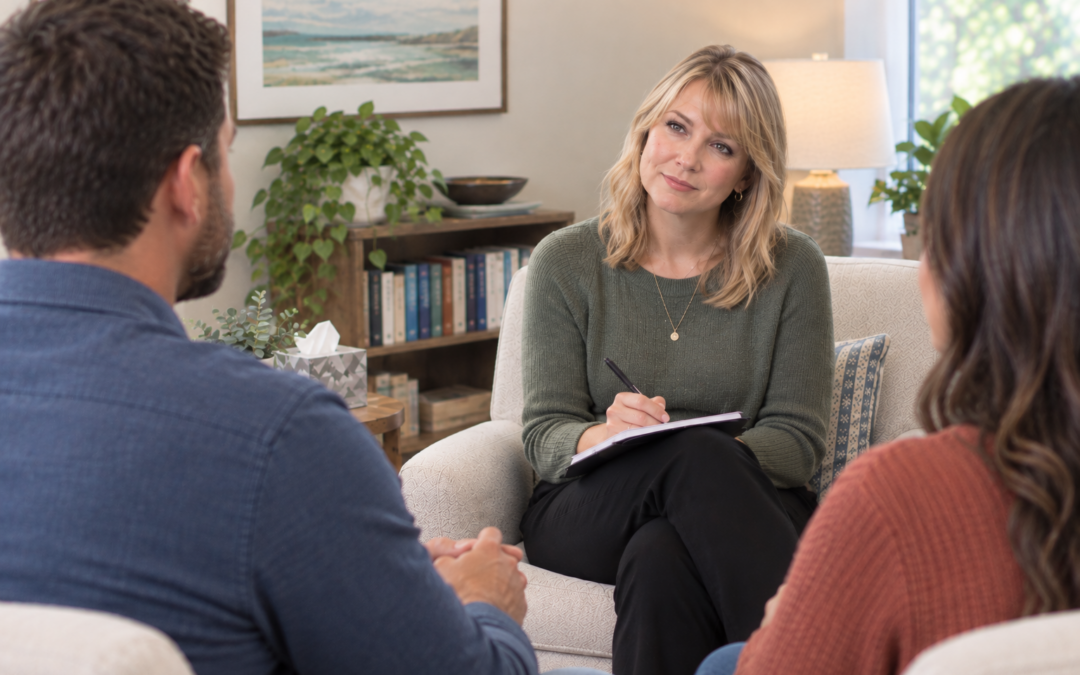
And I went — oh, I know this move. Prescribing the symptom. I’d used it just days before I watched this episode. Had a couple sitting on my couch doing the exact same dance, circling each other, not fighting, just quietly drifting further apart every session and pretending they weren’t. I named it. Told them to take the distance they were already living in and actually do it on purpose for two weeks — stop pretending the closeness was there when it wasn’t. It works. It genuinely works. It snaps a stuck pattern because now there’s something to push against instead of just drown in quietly.
So credit where it’s due. She did the right move.
But the depth wasn’t there. It just wasn’t.
Here’s my problem — and it’s the same problem I have with half the couples work I see, fictional or otherwise. You don’t get to skip to the clever intervention. Prescribing the symptom only lands if you’ve already cracked the thing open underneath it — the real, soft, unguarded feeling, not the surface fight. Not “you’re never around,” not the bickering about press and image. I mean Carolyn’s actual terror of disappearing into a role nobody asked her if she wanted. I mean John’s guilt — stuck between the woman he loved and a legacy that was handed to him, never chosen. That’s where this whole thing lives or dies. Not in the technique. Never in the technique.
I say this in every training I give, every supervision session, until my staff is probably sick of hearing it: emotion heals emotion. Not insight. Not a smart paradoxical assignment, however well-timed. You can hand two people the best intervention in the book and if you haven’t gotten them to actually feel the thing first — out loud, no armor, in front of each other — all you’ve built is behavior management. The bond underneath stays exactly as broken as it was.
If it were me in that chair, I’m not asking “what do you need from each other.” Too safe. I’d go for the nerve straight away. Carolyn — what does it cost you, every single morning, to put on the version of yourself the cameras are waiting for? John — when you watch her disappear into that role, what does it tell you about yourself that absolutely terrifies you? Those questions are uncomfortable on purpose. That’s the whole point. That’s where the marriage actually is, underneath all the managing of it.
We’ll never know if it would’ve mattered. The plane was always the plane — that’s the brutal part of writing about real people whose ending everyone already knows. But watching two strangers get reimagined for television, I did the thing I think every therapist does watching scenes like this, whether we admit it or not. I rewrote the session in my head. I kept reaching past the technique for the moment the feeling should’ve broken through. And for one second, sitting there with my wine going warm, I really did wish it had been me in that chair.
What Is “Prescribing the Symptom” in Couples Therapy?
Prescribing the symptom is a paradoxical intervention where a therapist asks a couple to deliberately, intentionally do the thing they’re already doing unconsciously — withdrawing, distancing, going quiet — instead of trying to suppress it. Making the behavior a conscious choice, rather than something that happens to them, often breaks a stuck pattern faster than direct advice would. It’s a technique I use regularly in my own practice with couples stuck in cycles of distance and resentment. But on its own, it’s incomplete — it manages behavior, not the emotional injury underneath it. That deeper layer is where the actual repair happens.
If any of this — the slow erosion of self inside a relationship, the quiet distance that’s easier to name than to fix, the gap between who you are and who you’re performing for someone else — sounds familiar, that’s the kind of work I do with couples every week at The Relationship Center, in person across Williamsburg, Norfolk, Virginia Beach, Chesapeake and Old Town Alexandria, and via Telehealth across Virginia and New York. Reach to today to schedule an appointment.