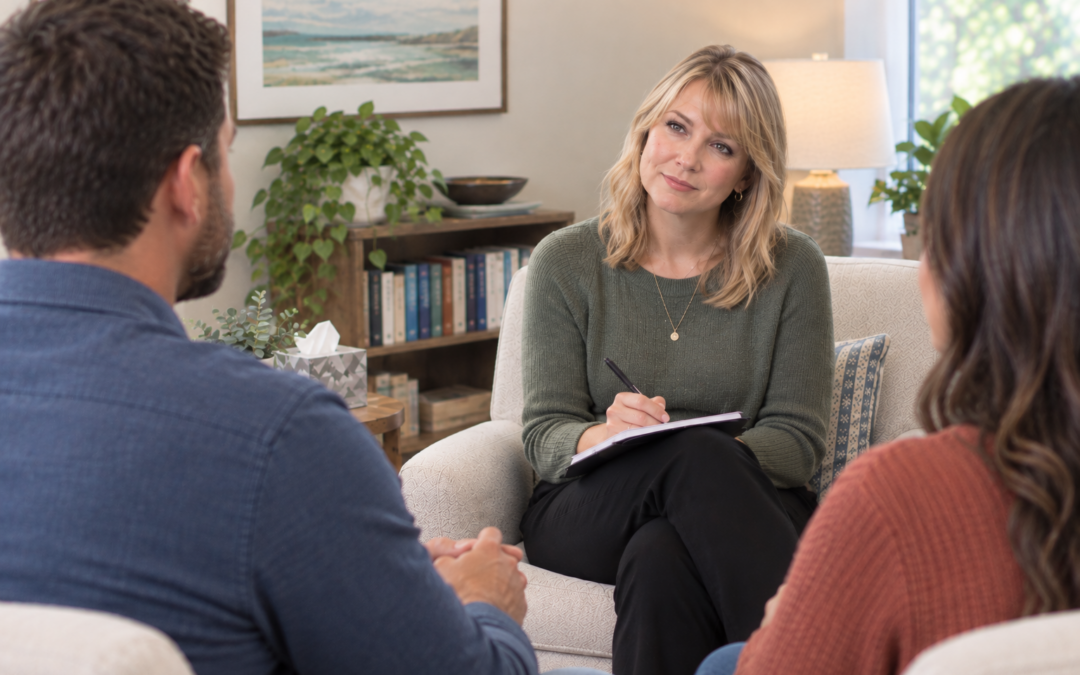
A couple is on my couch, halfway through a disagreement about the thermostat, when one of them goes quiet. Not thoughtful quiet. Gone quiet. Eyes on the floor, jaw set, and if I had a heart rate monitor on them, I’d bet it was reading well north of 100. John Gottman calls this flooding, and in more than 25 years of working with couples, I’ve learned that nothing productive happens after it starts. You can teach a flooded person every communication skill in the Gottman and EFT playbooks, and they still won’t be able to reach for them in the moment. The brain is busy with other things, mainly survival.
That’s a big part of why I’m glad to share this: beginning November 1, 2026, The Relationship Center of Hampton Roads will offer neurofeedback at our Williamsburg office. Maryam Tehrani, LMFT, BCB, has been providing neurofeedback for the past decade, and she’s bringing her services and her equipment to Williamsburg.
What Neurofeedback Is (It’s Less Sci-Fi Than It Sounds)
Neurofeedback is a form of biofeedback that teaches your brain to regulate itself by showing it, in real time, what it’s doing. Small sensors placed on the scalp read your brain’s electrical activity (EEG). That information is translated into something you can see or hear, like a video that plays smoothly or a tone that sounds, whenever your brainwave patterns move toward a healthier target. When they drift away from it, the feedback changes. Over repeated sessions, the brain learns to produce the more regulated pattern on its own.
It’s the same principle as learning to ride a bike. Nobody thinks their way into balance. Your nervous system gets feedback, adjusts, and eventually just knows.
No, Nobody Is Zapping Your Brain
This is the first question most people ask, usually with a nervous laugh. Neurofeedback sensors only read activity. Nothing is sent into your brain, no electrical current is delivered, and there’s nothing to feel beyond the sensors resting on your head. You sit in a comfortable chair and watch or listen. Some clients find it oddly relaxing, which, for people who arrive chronically wired, is its own small revelation.
What the Research Says, and Where It’s Still Catching Up
Neurofeedback has the strongest evidence for ADHD. The American Academy of Pediatrics rated biofeedback as a Level 1, “best support,” intervention for ADHD in 2012. A 2009 meta-analysis by Arns and colleagues in Clinical EEG and Neuroscience found large effects for inattention and impulsivity and a medium effect for hyperactivity. A 2019 meta-analysis by Van Doren and colleagues in European Child & Adolescent Psychiatry found those improvements held, and in some cases grew, at follow-up months later. That durability matters. It suggests the brain is actually learning something, not just responding while the sensors are on.
The evidence for trauma is newer but striking. In a 2016 randomized controlled trial published in PLoS One, Bessel van der Kolk and colleagues gave adults with chronic PTSD 24 sessions of neurofeedback. Afterward, 72.7% of the neurofeedback group no longer met criteria for PTSD, compared with 31.8% of the control group.
Now the part a responsible clinician includes. A 2016 meta-analysis by Cortese and colleagues in the Journal of the American Academy of Child & Adolescent Psychiatry found that ADHD effects were smaller when the people rating symptoms didn’t know who had received treatment. Research on anxiety, sleep, and emotional regulation is promising but built on smaller studies. Neurofeedback is not a cure-all. It is a well-studied tool that helps many people, and I’d rather tell you that plainly than oversell it.
Why a Relationship Practice Is Offering Brain Training
Because every relationship is two nervous systems in a room. My training in PACT taught me to watch the body before the words, and what I see, again and again, is that the couples who struggle most aren’t short on insight. They’re short on regulation. One partner escalates, the other shuts down, and both understand exactly what went wrong about three hours later.
Neurofeedback works on the regulation side of that equation. For a partner with ADHD who keeps losing the thread of conversations (and getting accused of not caring), for a trauma survivor whose alarm system fires at a raised voice, for the person who lies awake replaying every argument, a calmer, more flexible nervous system makes the work we do in couples and individual therapy far easier to use when it counts. It pairs naturally with the trauma-focused approaches our clinicians already use, including EMDR, Brainspotting, and IFS.
Who Neurofeedback Can Help
Neurofeedback may be a good fit if you’re dealing with attention and focus problems, including ADHD; anxiety that seems to live in your body more than your thoughts; the aftermath of trauma, including PTSD; trouble sleeping; or emotional reactivity that shows up faster than you can manage it. It can be used on its own or alongside therapy. If you take medication for any of these concerns, neurofeedback can typically be added without changing it, and any medication decisions stay between you and your prescriber.
The best way to know whether it fits your situation is a conversation with Maryam.

What a Neurofeedback Session Looks Like
Your first appointment focuses on assessment: what’s bringing you in, your history, and your goals. From there, sessions follow a consistent rhythm. Sensors are placed on your scalp, and you spend the training portion watching or listening while the software responds to your brain activity. Most people notice changes gradually, and neurofeedback protocols commonly run 20 to 40 sessions, often once or twice a week. Side effects are uncommon and usually mild, such as temporary tiredness or a light headache after a session.
Meet Maryam Tehrani, LMFT, BCB
Maryam is a Licensed Marriage and Family Therapist and holds board certification in biofeedback. She has been conducting neurofeedback sessions for the past ten years, which means she brings something you can’t get from a weekend certification: a decade of watching how real people’s brains respond, adjusting protocols, and knowing when to be patient. At TRC, she also anchors our work with intercultural and third-culture couples. Starting November 1, she’ll be seeing neurofeedback clients in person at our Williamsburg office with her own equipment.
Frequently Asked Questions About Neurofeedback in Williamsburg
Does neurofeedback hurt? No. The sensors only read brain activity, and nothing is delivered to your brain.
Is neurofeedback the same as biofeedback? Neurofeedback is a type of biofeedback. Biofeedback can measure heart rate, breathing, or muscle tension; neurofeedback measures brainwave activity specifically.
How many sessions will I need? It varies by person and goal. Many protocols fall in the range of 20 to 40 sessions, and Maryam will give you a clearer picture after your assessment.
Can I do neurofeedback while I’m in therapy at TRC? Yes. It can complement individual or couples therapy, and many clients find the two reinforce each other.
When does neurofeedback start at the Williamsburg office? Neurofeedback sessions with Maryam Tehrani begin at TRC’s Williamsburg office on November 1, 2026.
If Your Nervous System Has Been Running the Show
If you’ve ever walked out of an argument knowing exactly what you should have said, or tried every strategy and still felt your body hijack the moment, you’re not failing at therapy. You may just need a different way in. Neurofeedback offers one, and Maryam is very good at it.
To ask about neurofeedback or schedule a consultation, reach out to us at relationshipcenterva.com. We’d be glad to talk through whether it’s a fit for you.